

Most people can name the vitamins on a label. Choline is the one they skip past. It sits in the middle of the list on a women's daily formula, there is no letter attached to it, and it rarely gets a headline. Yet it is a nutrient most adults don't get enough of from food, and women's needs for it can change with age.
Here is what choline is, what it does in the body, where you get it, and how much a daily formula actually holds, using Foundations Women's Health Support as the worked example.
A nutrient that got its official status late
Choline is a water-soluble nutrient that often gets grouped with the B vitamins, though it isn't technically one. The body can make a small amount in the liver, but not enough to cover what it uses, so the rest has to come from food. That is why the U.S. National Academy of Medicine (then the Institute of Medicine) formally recognised it as an essential nutrient in 1998 and set a daily Adequate Intake for it.
For adult women, that Adequate Intake is 425 mg a day. It rises to 450 mg during pregnancy and 550 mg while breastfeeding. For adult men it is 550 mg.
What choline does in the body
Choline has three main jobs, and each one explains a different reason it turns up in a women's formula:
- Cell membranes. The body uses choline to build phosphatidylcholine, one of the main structural fats in the membrane around every cell.
- Nerve signalling. Choline is the starting material for acetylcholine, a messenger the nervous system uses for memory, mood and muscle control.
- Liver function. The liver packages fat into particles so it can be carried out to the rest of the body, and that packaging needs phosphatidylcholine. Adequate choline supports normal liver function, which matters for a women's formula because the liver is also where the body processes hormones such as estrogen.
Choline also feeds the body's methylation cycle, the same system that relies on folate and B12. That is one reason it sits next to methylfolate and methylcobalamin in the same packet rather than on its own.
Why women's needs can shift with age
The small amount of choline the body makes for itself comes mostly from one liver pathway, and estrogen helps switch that pathway on. Researchers have found that many younger women make more of their own choline as a result. Later in life, as estrogen levels naturally decline, the body makes less, and more of the day's choline has to come from food.
Pregnancy and breastfeeding raise the need too, which is why the Adequate Intake goes up at those stages.
Where it comes from in food
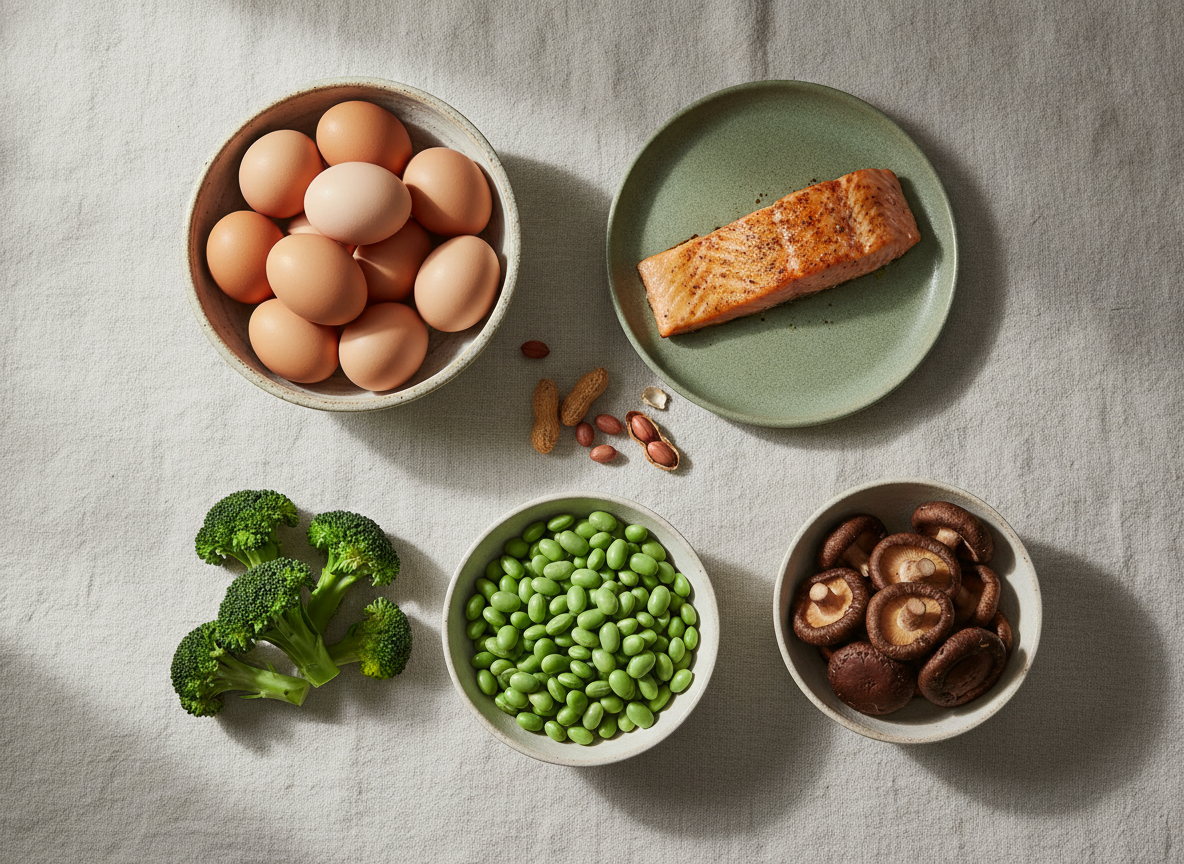
The richest everyday source is egg yolk. One large egg holds roughly 147 mg of choline, about a third of a woman's daily target. Beef, chicken, fish, soybeans, wheat germ, shiitake mushrooms and cruciferous vegetables such as broccoli and Brussels sprouts all add smaller amounts.
Even so, national U.S. survey data suggest that only around one in ten adults reaches the Adequate Intake, and women's average intake sits well below 425 mg. People who eat few eggs or little animal food tend to land lowest.
How much is in the formula
The Foundations Women's label lists 150 mg of choline bitartrate inside the Elanivra™ Women's Blend in the Morning packet, alongside maca root, DIM, inositol and a full B-complex.
It is worth reading that number precisely. Choline bitartrate is a salt, and only about 41 percent of its weight is choline itself. So 150 mg of choline bitartrate supplies roughly 60 mg of actual choline, around 14 percent of the 425 mg target.
That is by design. A daily formula isn't trying to replace eggs or meat; it tops up what food already brings in. If you eat eggs most mornings, the formula adds a modest amount on top. If you rarely do, food still has to carry most of the load, and that is worth knowing rather than assuming a capsule has it covered.

How to take it
The label keeps this simple: take the entire Morning packet during the day with food and 8 oz of water. Breakfast is the natural fit, and taking the packet with a meal also helps the fat-soluble nutrients in it, such as vitamins D3, K2 and E, absorb better.
A few things worth knowing:
- Count every source. If you take a separate choline, lecithin or prenatal product, add up the total. The upper limit for adults is 3,500 mg a day, far above what is in this formula, but stacking several products is how people drift toward it.
- Look at your plate first. Eggs, fish, meat, soy and cruciferous vegetables are where most choline comes from. The formula is a top-up, not the main source.
- If you are pregnant or nursing, take medication, or have an ongoing health concern, talk with a qualified healthcare professional before adding a new supplement.
The takeaway
Choline is an essential nutrient most women don't get enough of from food, and the body's own supply tends to fall with age. It helps build cell membranes, supports nerve signalling and supports normal liver function, including the liver's role in processing hormones. In Foundations Women's Health Support, it appears as 150 mg of choline bitartrate in the Morning packet, a modest daily top-up that works alongside a choline-rich diet.
These statements have not been evaluated by the Food and Drug Administration. This product is not intended to diagnose, treat, cure, or prevent any disease.